Fluoride vs. Nano-Hydroxyapatite: Do You Really Have to Choose?

If you have spent any time scrolling through wellness content lately, you have probably seen the debate: fluoride toothpaste versus “natural” toothpaste with hydroxyapatite. The discussion has moved well beyond dental offices and into social media feeds, parenting groups, and health podcasts. Personally, I think that is a good thing. People are paying attention to what they put in their mouths, and as a dentist who has always believed that an informed patient makes the best patient, I welcome the conversation.
What I do not welcome is misinformation, fear-based marketing, and the oversimplification that often comes with it. The truth is that choosing between fluoride and hydroxyapatite should not be about fear and competition. Both ingredients share the same goal: preventing cavities.
Your Teeth Are Already Made of This Stuff
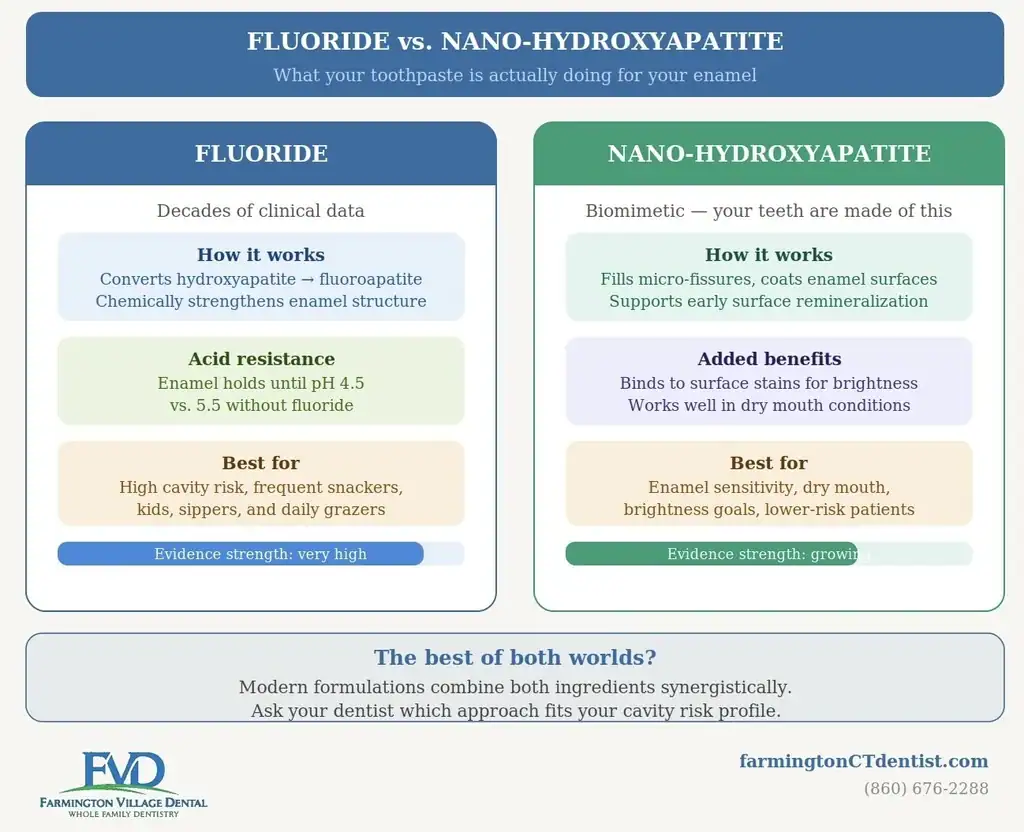
Hydroxyapatite is the natural mineral that makes up the majority of your tooth enamel. Your teeth are literally made of this! When a toothpaste company tells you that hydroxyapatite is “biomimetic,” that is actually accurate. It simply means that the material mimics what is already naturally present in your tooth. Man-made
With hydroxyapatite the size, shape, concentration and quality of the crystals all matter.
First, the most effective size has turned out to be “nano” sized particles, aka nanohydroxyapatite or nHAp.
The most effective shape of nHAp particles is the rod.
The most effective concentration of nHAp is 10%.
Once all those parameters are achieved the last key component of an effective hydroxyapatite toothpaste is crystal quality. The higher the quality of crystals the more effective the toothpaste will be.
So what does nHAp do? The short answer is it serves to smooth enamel.
nHAp particles are small enough to fill in micro-fissures and coat enamel surfaces, creating a smoother structure that reflects light more evenly. This is why nHAp toothpastes are associated with enhanced brightness and some people think nHAp is “whitening”. The truth is that nHAp can not inherently change the color of your teeth and bleach them. Instead, by making the surface of the teeth smoother and more uniform it helps to reflect light off the teeth in a way that the teeth appear brighter and more uniform. These same particles also attach to food and beverage stains during brushing, which helps offset daily discoloration from coffee, wine, and certain foods.
Some people question whether nano-hydroxyapatite penetrates into tissues or ends up in the brain. Studies have shown that nHAp does not penetrate the oral lining or tissues, and it does not cross the blood-brain barrier. When swallowed, it dissolves in the stomach and breaks down into its basic components — calcium, phosphate, and oxygen. The safety profile is well-established, and the efficacy in enamel remineralization is scientifically documented when the product is formulated at the right concentration.
Not All nHAp Is Created Equal
This is where it gets interesting and it’s where a lot of toothpaste companies can mislead consumers.
The fluoride-free toothpaste category is not regulated by the FDA the same way that fluoride toothpastes are. Thus, the nHAp market is essentially the Wild West right now. Companies are out there saying anything they want to sell their product and they don’t have to prove their claims. Let’s just say there is a wide spectrum of product quality out there.
Think about nHAp like diamonds. Everyone knows that diamonds vary in size, cut, color and clarity, and each category is important to the value of the diamond. The same is true for hydroxyapatite crystals. Crystal size, shape, concentration, and quality are all important factors when it comes to the performance of the product in the mouth. Each affect how the product adheres to tooth enamel and how effectively it supports enamel remineralization.
Your enamel can tell the difference between a high-quality product with the right size, shape and concentration of nHAp and a lesser quality product, even when the label of the toothpastes look the same. Sadly, many venture-backed toothpaste companies prioritize scale and margin efficiency, which means they often use lower-grade, lower-performing nHAp crystals. The result is a product that looks good on a shelf and sounds impressive in an Instagram caption, but does not actually deliver meaningful cavity protection. All of this has real consequences that I am seeing more and more frequently: patients who rely on an underperforming toothpaste for cavity prevention find themselves getting more cavities over time.
Now Let’s Talk About Fluoride
While hydroxyapatite is having its moment, fluoride has had decades of studies behind it, and that track record is not something to dismiss. Fluoride is the most proven cavity-preventive ingredient available in toothpaste, and it is especially effective in high-risk patients, including young children and anyone with a history of frequent cavities.
It’s time for some chemistry, and I promise it is worth understanding. Fluoride does not simply smooth out enamel the way nHAp does. It actually changes the chemistry of the enamel by substituting a hydroxyl molecule in hydroxyapatite with a fluoride molecule. The result is a new compound called fluorapatite, and fluorapatite is meaningfully more acid-resistant than the hydroxyapatite your teeth started with.
Remember the pH scale from chemistry class? Lower numbers mean something is more acidic. Enamel begins to dissolve when the pH in your mouth drops below a critical threshold. Hydroxyapatite, your tooth’s natural material, starts to dissolve at around a pH of 5.5. Fluorapatite, the compound fluoride helps create, holds up until around pH 4.5. That difference of one pH unit may not sound dramatic, but the pH scale is logarithmic, which means fluorapatite is ten times more resistant to cavity causing acid than plain hydroxyapatite.
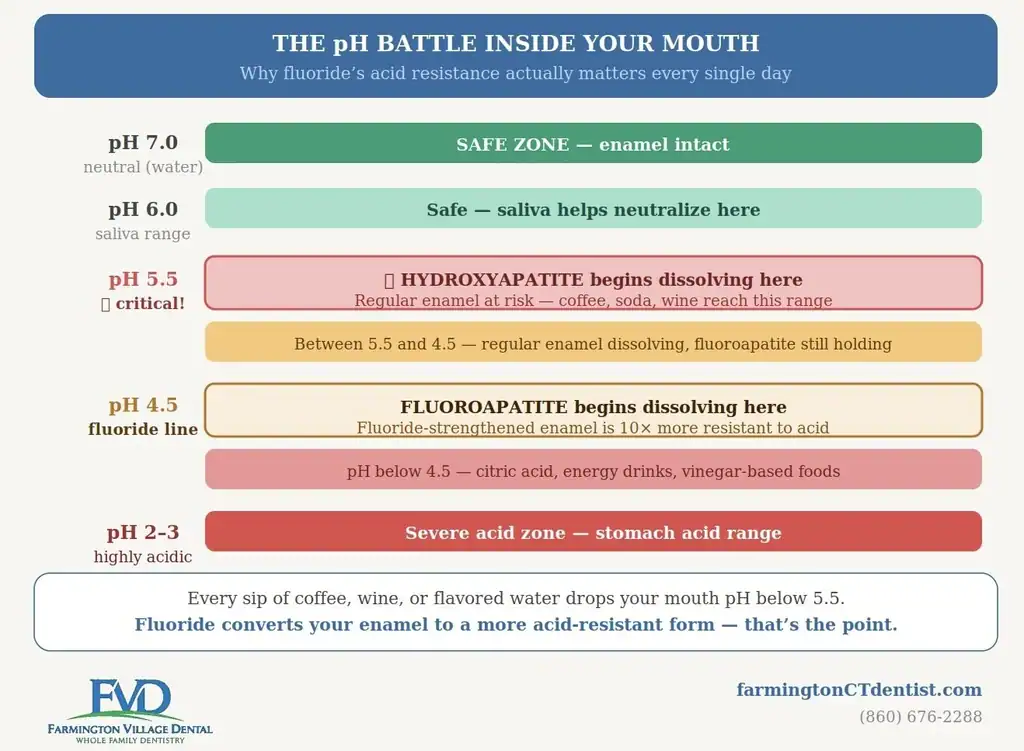
This matters enormously if you are someone who sips coffee throughout the morning, snacks between meals, drinks flavored sparkling water, or does not floss consistently. Every time you eat or drink something other than water, the pH in your mouth drops and your enamel is under acid attack. Fluoride helps your enamel weather that attack.
The one drawback worth noting is that fluoride’s efficacy is reduced in a dry mouth, while nHAp actually performs reasonably well in dry mouth conditions.
The Best of Both Worlds
The debate between fluoride and hydroxyapatite is being framed as a competition when it does not have to be. The most exciting development in this space is the emergence of toothpastes that use both ingredients together synergistically as partners. A formulation that delivers the acid-resistance of fluorapatite alongside the biomimetic remineralization of high-quality nHAp represents genuinely modern preventive care.
Finally, remember the basics: your toothpaste doesn’t matter if you are not brushing correctly! Both fluoride and nHAp work best when the toothpaste is given time to do its job. That means brushing for at least two minutes and, critically, not rinsing the product off when you are done. Rinsing immediately washes away the active ingredients before they have had a chance to work.
My recommendation for optimal technique is this: floss first, then rinse out any dislodged debris either with water or with a 50/50 mixture of water and hydrogen peroxide. Then brush, and do not rinse again. Let your toothpaste stay on your teeth.
So, What Should You Use?
This depends on your risk profile. If you have a history of frequent cavities, if you have young children, if you snack throughout the day, or if you take medications that cause dry mouth, fluoride-containing toothpaste is still the gold standard for cavity prevention based on the totality of evidence. Better yet, find a product that has both and all of your bases are covered.
If you are interested in exploring only nHAp products, look for formulations that specify they are 10% nano-hydroxyapatite and treat influencer endorsements with the same skepticism you would apply to any unregulated wellness product.
And as always, bring your questions to your next appointment. This is exactly the kind of conversation I love having, because the more you understand about how your teeth work, the better equipped you are to take care of them.